For growing companies that lose knowledge when people leave.
When your best person leaves, their knowledge leaves with them.
askSOPia captures how your organisation actually works — the decisions, processes, and context your team depends on — before the next resignation forces you to find out what's missing.
Built With Industry Leaders
Developed in partnership with companies who needed it most.
We co-developed askSOPia with organisations across tax advisory, manufacturing, and healthcare — solving real knowledge challenges in real environments.
Co-developed knowledge capture methodologies for tax advisory. One Sprint session structured 45 documents in a single hour.
Pioneered video-based knowledge extraction for the factory floor. Workers demo processes on camera, askSOPia turns them into SOPs.
Adapted askSOPia for healthcare. Administrative SOPs captured and structured, optimising operations regardless of staff changes.
The Hidden Cost
Every week, your company loses knowledge it can't get back.
It's not dramatic. It's slow, invisible, and compounding.
Decisions get re-debated every quarter
The reasoning behind past decisions is gone. Leadership bandwidth is burned re-litigating settled questions instead of moving the company forward.
One resignation resets progress
When your head of operations leaves, execution speed drops overnight. Their successor inherits the role, not the context, shortcuts, relationships, or escalation paths.
Consistency breaks as you scale
New hires guess how things work. Standards drift. Quality drops before leadership notices. Onboarding stretches from weeks to months.
No audit trail when it matters
You can't prove why a decision was made — or who owned it. That becomes a real problem when clients, regulators, or buyers start asking questions.
None of this shows up in dashboards. It shows up when things slow down, break, or get risky.
This is not a documentation problem.
How Most Clients Start
A 4-week Knowledge Sprint to capture what matters most.
Most clients start with a focused Knowledge Sprint — a consulting engagement that maps your biggest knowledge risks and delivers a structured card library you keep forever. No subscription required.
90% of Sprint clients become Professional subscribers within 90 days.
Your corporate memory doesn't leave when people do.
How It Works
How it works — from tribal knowledge to operational memory
Capture
Knowledge is captured from real work — meetings, documents, conversations — without anyone having to stop and document.
Build operational memory
Day-to-day work becomes structured corporate memory — process, decision, and knowledge cards. No manual tagging. No maintenance burden.
Execute with clarity
Teams get cited answers instantly — without escalating to leadership or depending on one person who knows.
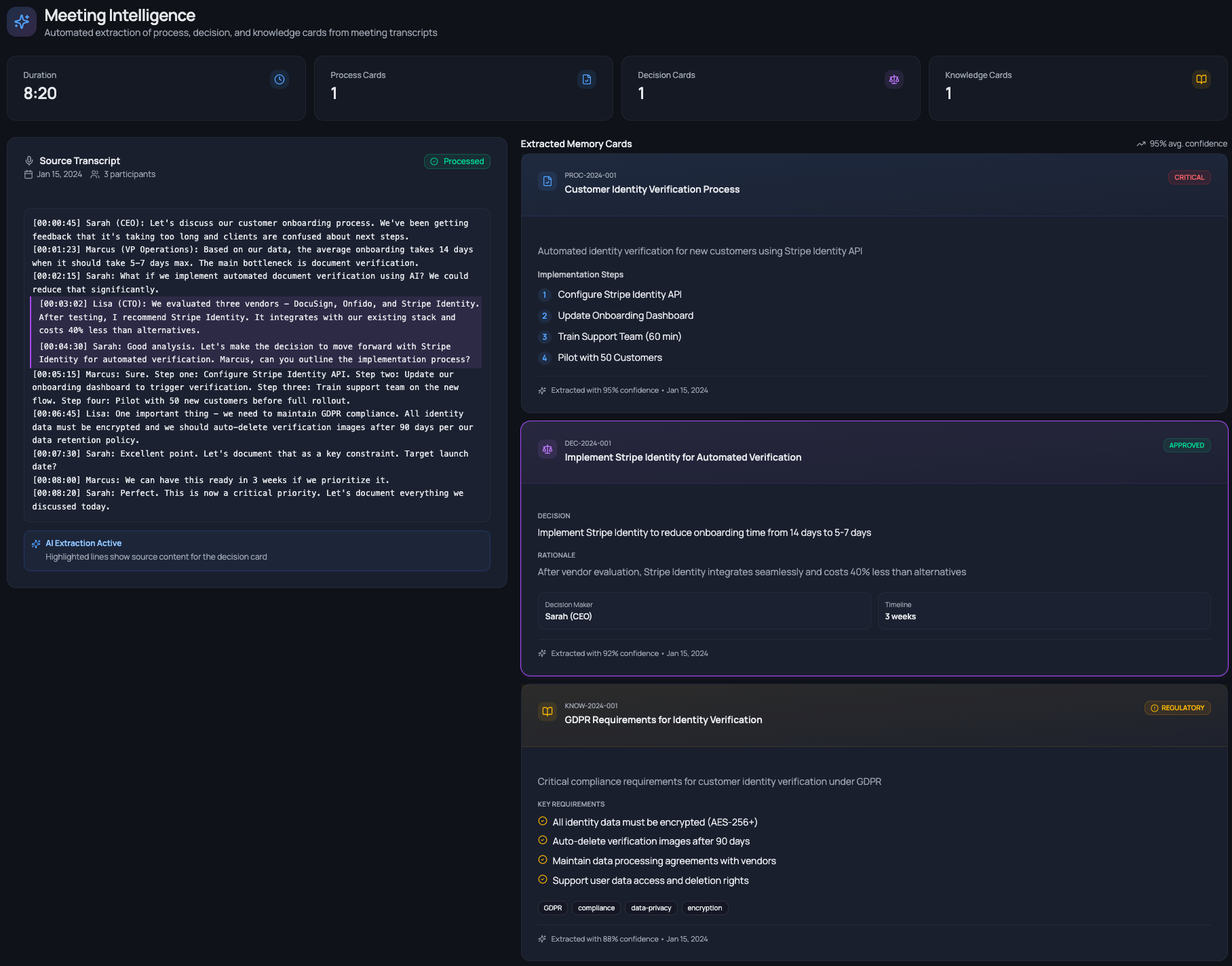
Turn meetings into corporate memory
Upload a meeting transcript. askSOPia's AI extracts decisions, operational processes, and shared knowledge into structured cards — automatically.
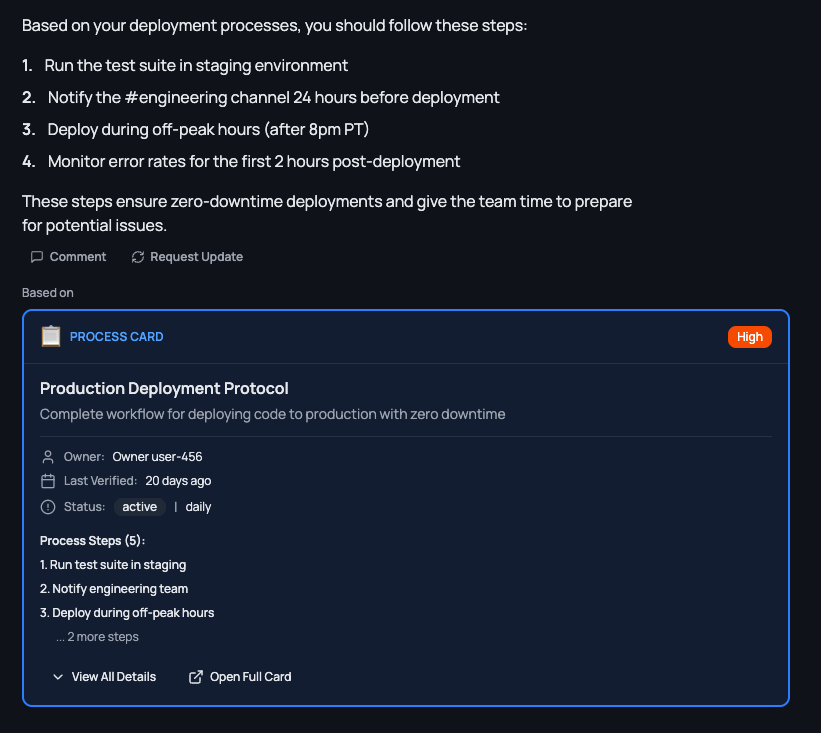
Chat with Citations
Get defensible answers to operational questions — with citations to the exact source.
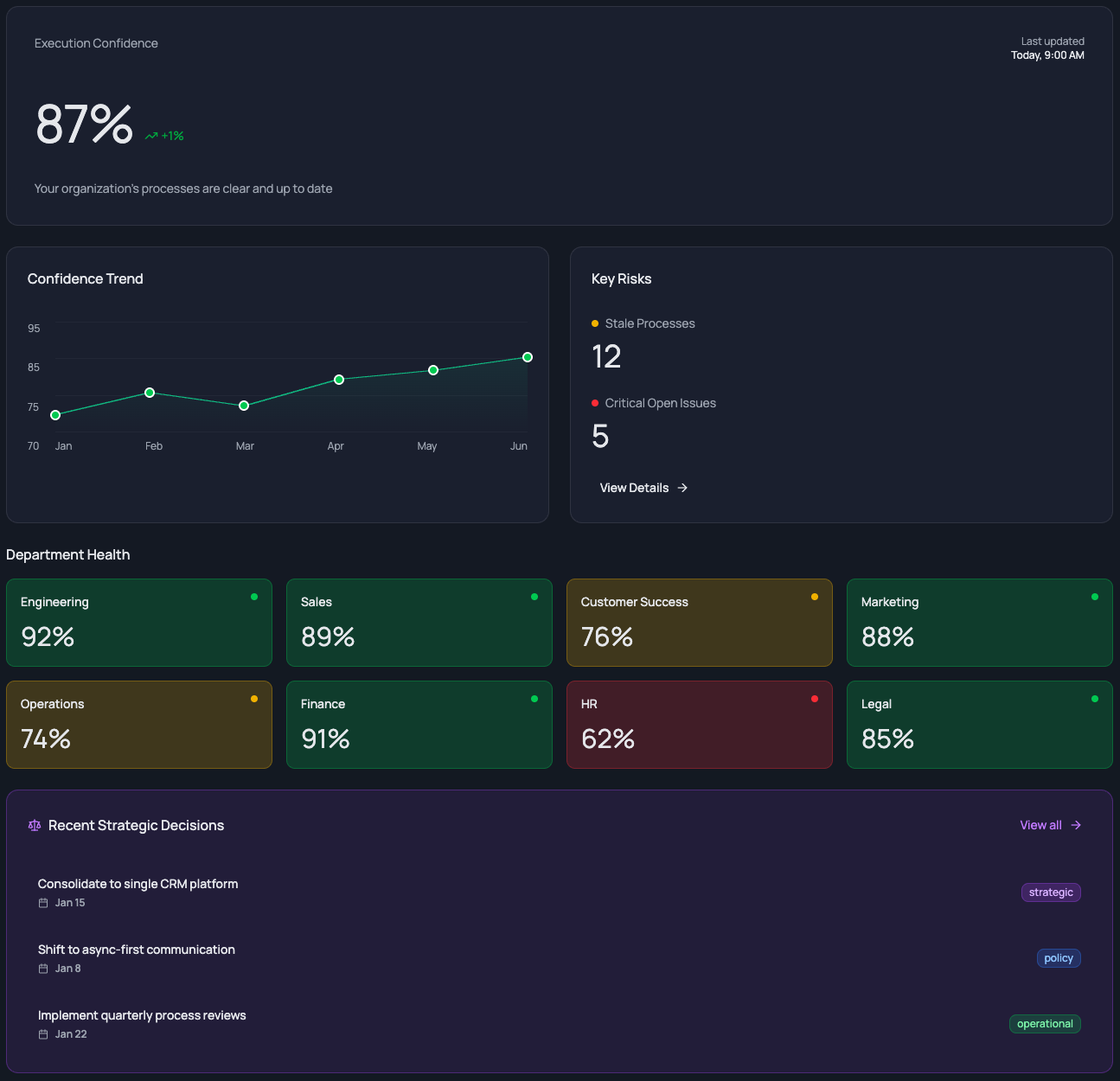
Readiness Signals
See where your corporate memory is strong, where it's aging, and where execution depends on one person.
Why askSOPia for corporate memory
Not a replacement for your current tools. A corporate memory layer over them.
| Feature | Traditional knowledge bases | Process tools (SOP/workflows) | askSOPia |
|---|---|---|---|
| Operational processes stay current | ✕ | ✓ | ✓ |
| Decision context preserved | ✕ | ✕ | ✓ |
| AI answers with citations | ✕ | ✕ | ✓ |
| Extracts from meetings automatically | ✕ | ✕ | ✓ |
| AI voice interviews for knowledge capture | ✕ | ✕ | ✓ |
| Shows knowledge risk | ✕ | ✕ | ✓ |
Who This Is For
Built for growing companies that feel operationally fragile
You've grown past the stage where things "just work" — and now they break when key people are absent.
You're hiring fast, but onboarding is slow — because critical knowledge lives in people's heads, not in a system.
You're preparing for an acquisition, audit, or leadership transition — and you need operational clarity yesterday.
Not another tool for everyone. A safeguard for leadership.
Risk-free
40% less time re-explaining past decisions within 90 days — or we refund your investment in full.
No questions. No clauses. We only win if you win.
Not a sales call
Find where your organisation is bleeding knowledge.
20 minutes. No preparation needed. You'll leave knowing exactly where your biggest knowledge risks are — and how to fix them.
Limited to 5 assessments per month
- Map of your top 3 knowledge risk areas
- Specific recommendations to fix them
- Cost of inaction