Knowledge Management: Definition, Methods and Software
Knowledge management means what your company knows survives every personnel change. Here's the definition, the methods that work, a software overview — and why classic wikis fail at it.
Knowledge management covers all methods and systems a company uses to systematically capture, share, use, and maintain its knowledge — from documented processes and decision rationale to the experience of individual employees.
The core problem: 80% of relevant knowledge is tacit — it lives in heads, not documents. Filing documents is document management, not knowledge management. In a 150-person company, that difference costs roughly €500,000 a year: knowledge lost with departures, repeated mistakes, and long ramp-up times.
Tacit vs. explicit knowledge
The most important distinction in knowledge management — because each kind needs different tools:
Explicit knowledgeDocumentable and documented: handbooks, process descriptions, contracts. Can be filed, searched, versioned.
Tacit knowledgeExperience, judgment, relationships: why a decision was made, how a difficult client works, which shortcut actually holds. Lives in heads — and leaves with them.
The gap between themClassic systems only capture explicit knowledge. Tacit knowledge must be actively harvested: through interviews, meeting extraction, and documented decisions.
The 5 methods that work in practice
1.Process documentation (SOPs)
Recurring workflows as verified step-by-step procedures — the foundation. Short, versioned, with review dates.
2.Decision documentation
What was decided, why, and what alternatives existed? Prevents teams from rerunning old debates and repeating old mistakes.
3.Knowledge-transfer interviews
Structured conversations with experience carriers — especially before exits and retirements. Record, extract, link.
4.Meeting extraction
Most knowledge is spoken in meetings and then forgotten. AI extraction from transcripts turns it into durable knowledge assets.
5.Linking & maintenance
Knowledge ages. Every asset needs an owner, a review date, and links to related processes and decisions.
Knowledge management software: the 4 categories
The market sorts into four categories — with very different strengths:
Wikis & documentation (Confluence, Notion, SharePoint)Strong at storing, weak at staying current. The typical end state: a document graveyard nobody trusts.
Process & project tools (Asana, Monday)Manage tasks, not knowledge. The why behind the work disappears the moment the ticket closes.
Enterprise search & AI assistants (Glean, Copilot)Search what exists — but can't harvest what only lives in heads, and often answer without reliable sources.
Active knowledge systems (askSOPia)Extract knowledge from meetings and interviews, structure it as verified cards, and answer questions with citations. EU-hosted, GDPR-compliant.
AI in knowledge management: from archive to memory
AI changes knowledge management in two places. At capture: a meeting transcript or handover interview becomes structured process, decision, and knowledge cards automatically — eliminating the documentation labor every wiki project dies on. At use: employees ask in natural language and get answers that cite the verified cards — not hallucinations, but traceable sources.
That turns a passive archive into an active corporate memory: the knowledge graph shows how processes, decisions, and people connect — and where concentration risks sit, before anyone resigns.
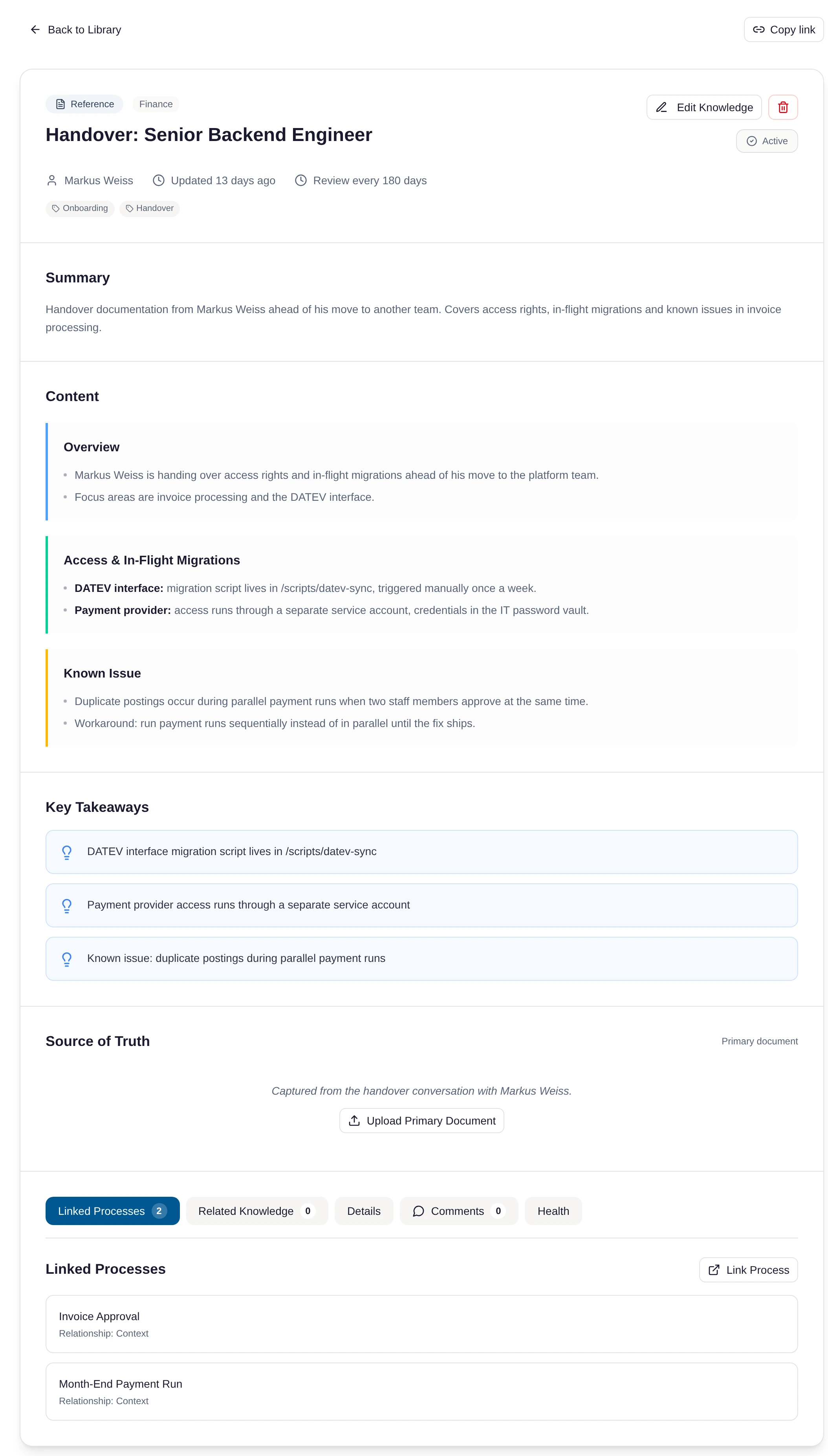
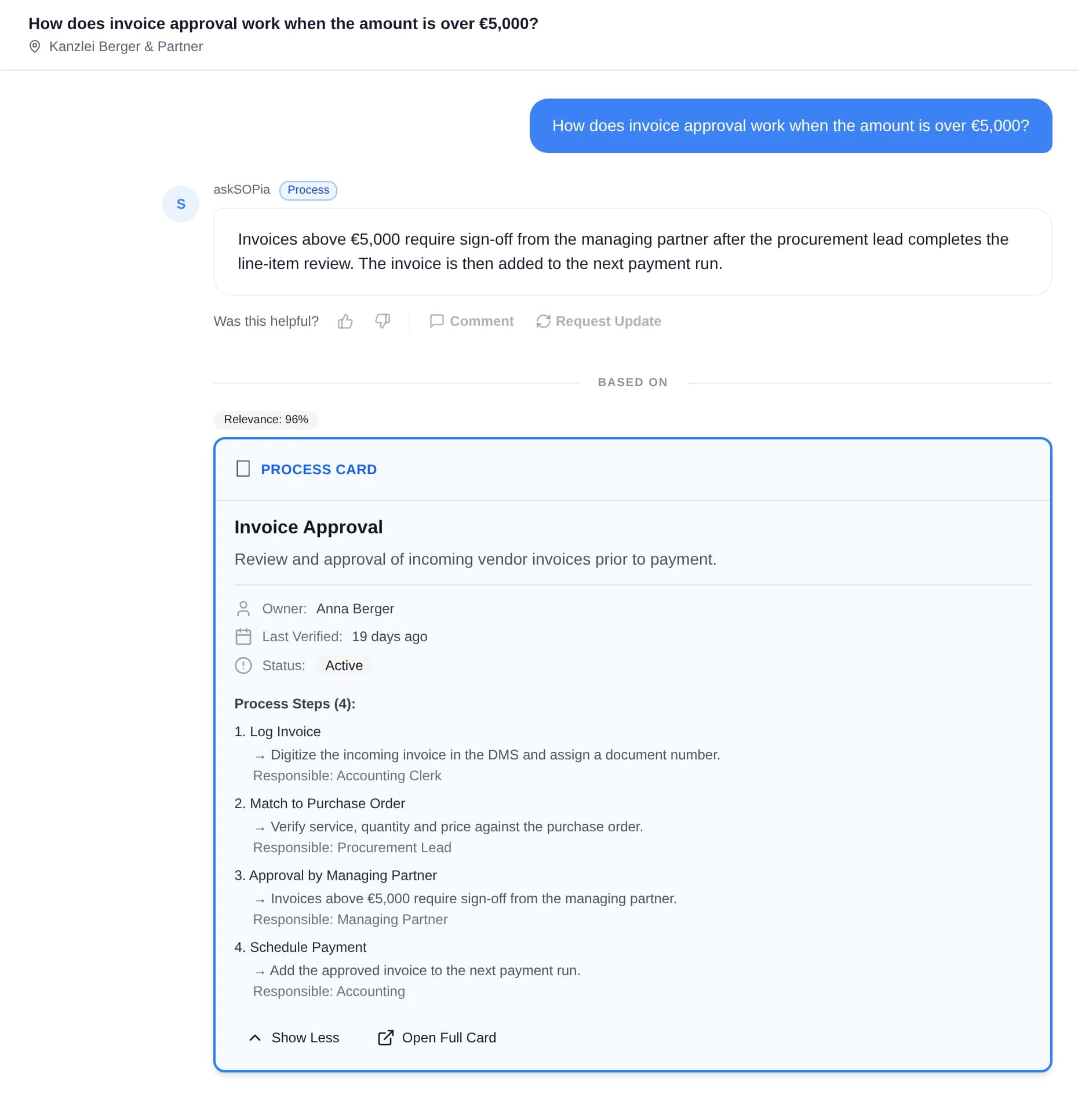
Experience as a verified card: a senior engineer's handover, linked to 12 process cards.Cited answers: every statement references the underlying card.
Frequently Asked Questions
All methods and systems a company uses to capture, share, use, and maintain its knowledge — explicit knowledge (documents, processes) as well as tacit knowledge (experience, decision rationale, relationships).
Five carry the weight in practice: process documentation (SOPs), decision documentation, knowledge-transfer interviews, AI extraction from meetings, and systematic maintenance with owners and review dates. Classic methods like communities of practice and mentoring complement them.
Three questions decide: Does the system harvest tacit knowledge (not just files)? Does knowledge stay verified and current (owners, review dates)? Are answers evidence-backed (citations instead of AI hallucinations)? Wikis usually fail all three.
Conservatively, about €500,000 a year for a 150-person company: knowledge lost in personnel changes, duplicated work, repeated mistakes, and extended onboarding. The baby-boomer retirement wave sharpens the risk.
Yes. askSOPia is hosted in the EU (Azure European Cloud), processes data in compliance with GDPR, and provides role-based access control at card and department level.