
Onboarding Process: Phases, Checklist & the 30-60-90 Plan

Good onboarding isn't a welcome gift — it's a process. Here are the 4 phases, a 30-60-90 onboarding plan template, and the lever that makes new hires productive 3x faster.

GDPR CompliantEU Data Residency

What does an onboarding process include?

The onboarding process covers every step from signed contract to full productivity — organizational (workspace, access, paperwork), social (team, culture, key contacts), and professional (tasks, processes, knowledge).

The professional layer decides how long it takes. New hires lose most of their time not to learning but to searching: for the right contact, the current process, the reason behind a rule. That's exactly where a good onboarding plan intervenes.

The 4 phases of onboarding

1.Preboarding (before day 1)

Contract, equipment, access, and the onboarding plan are ready. The new hire knows what week 1 looks like.

2.Orientation (week 1)

Team, workspace, core systems, and the 5 key processes of the role. Goal: confidence, not completeness.

3.Ramp-up (weeks 2–8)

Own tasks with growing independence, supported by a mentor. Every open question gets documented — it marks a knowledge gap in the company.

4.Integration (months 3–6)

Full ownership, first improvement proposals, feedback conversations. Onboarding ends with a review, not with silence.

The 30-60-90 onboarding plan template

An onboarding plan answers three questions per phase: what should the person be able to do, how is it measured, and who supports them?

Days 1–30: UnderstandKnow the role's core processes, meet the key people, complete first supervised tasks. Milestone: can explain the 10 most common workflows.
Days 31–60: ApplyHandle standard cases independently; mentor only for exceptions. Milestone: standard tasks without follow-up questions.
Days 61–90: OwnFull responsibility for the area, first improvement proposals. Milestone: works independently; onboarding review completed.
ThroughoutWeekly check-in with the manager, documented open questions, a named mentor.

Onboarding checklist

Onboarding plan created and shared before day 1
Workspace, hardware, and all access provisioned
Mentor / buddy assigned
Core processes of the role documented and accessible
Meetings with key people scheduled for the first 2 weeks
Weekly manager check-ins on the calendar
Open questions collected and answered
30/60/90 milestones defined and measured
Feedback conversations after week 1 and month 1
Onboarding review after month 3

Why ramp-up takes too long — and the lever against it

The most expensive part of onboarding is invisible: a new hire interrupts colleagues dozens of times a week with questions whose answers are written down nowhere. How does client onboarding work here? Why do we use vendor A? Who's the right contact at client X?

With askSOPia, new hires ask those questions in chat — and get answers that cite the company's process, decision, and knowledge cards as sources. Our customers cut ramp-up time by 3x: questions cost seconds instead of meetings.
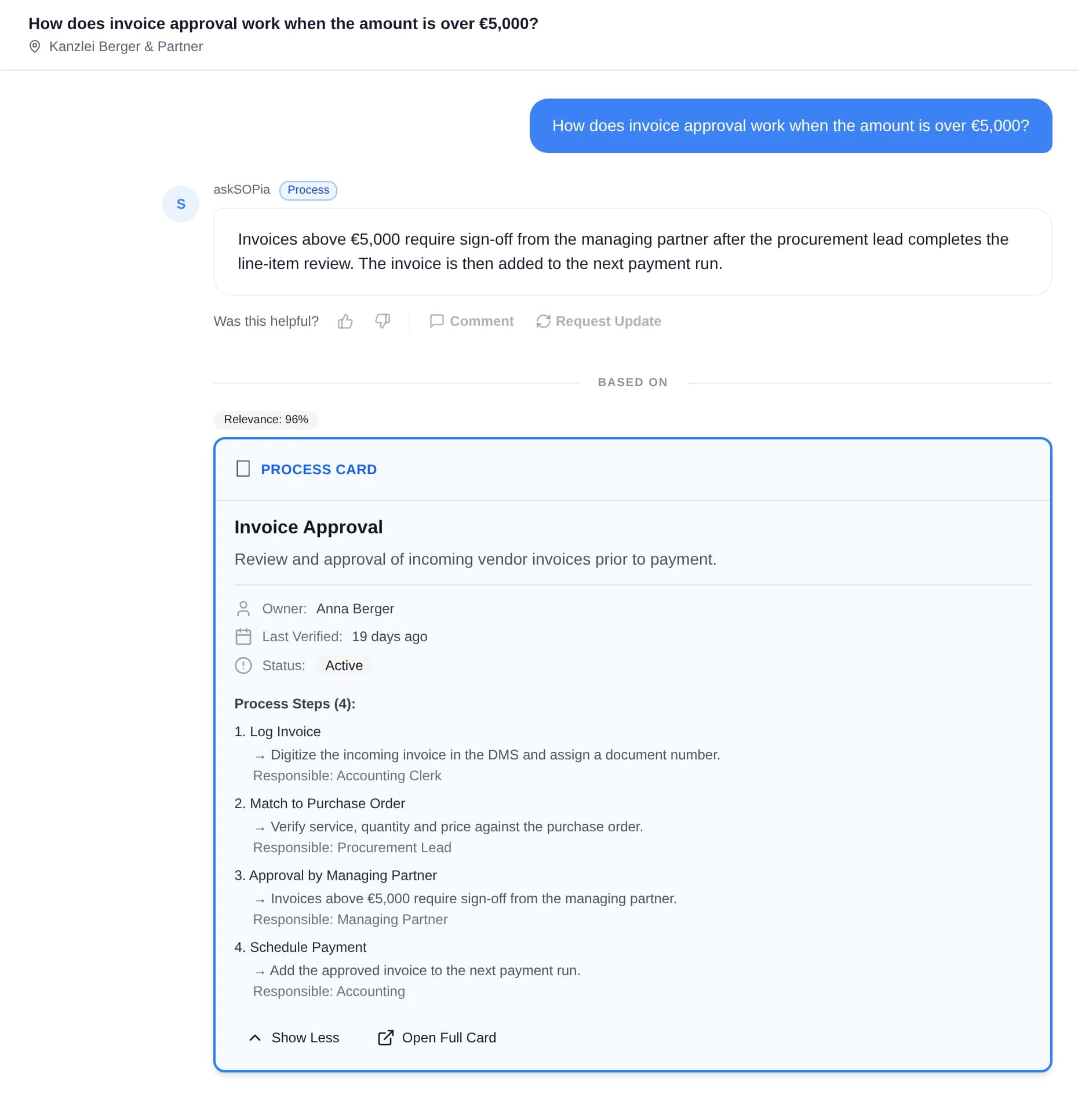
New hires ask in chat — every answer cites its source.
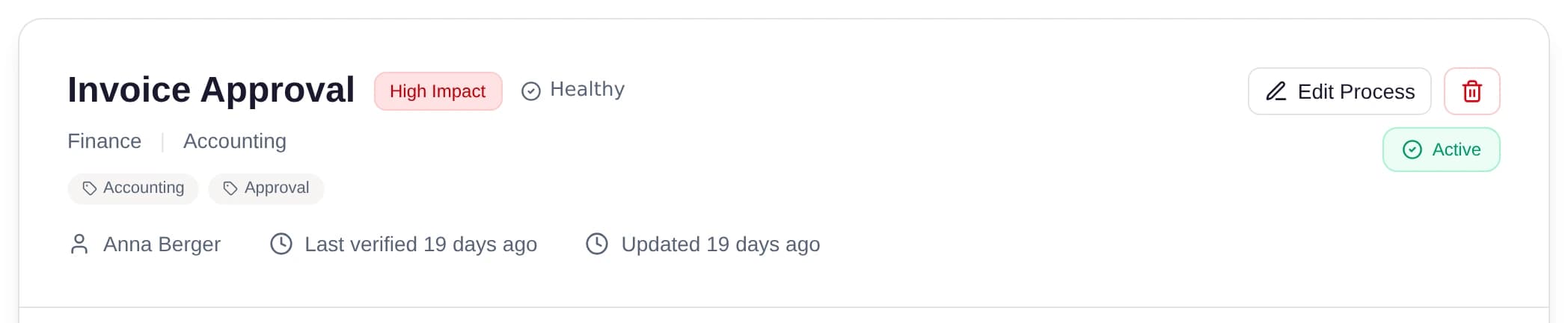
The process library: every core workflow of the role in one place, with verification status.

Frequently Asked Questions

Three to six months to full productivity, depending on the role. Structure matters more than duration: with documented processes and fast knowledge access, productive ramp-up typically shortens by 2–3x.

Per phase (30/60/90 days): learning goals, concrete tasks, milestones, and owners. Plus a named mentor, scheduled meetings with key people, and a fixed check-in rhythm.

Onboarding is the umbrella for the whole integration process (organizational, social, professional). Ramp-up is the professional part: learning the tasks, processes, and knowledge of the role.

Because the required knowledge lives in heads and scattered documents. New hires spend more time searching and waiting for answers than learning. Accessible, citable process knowledge is the single biggest lever.

Twice over: it extracts processes and knowledge from meetings and documents (instead of someone writing everything down), and it answers new hires' questions with cited sources — around the clock, without interrupting colleagues.

Keep reading

Next Step

Ready to Secure Your Knowledge?

Less than the cost of a bad first month of a mis-hire.

20 minutes. No slides. No prep needed.

Start the knowledge-risk checkSee the Knowledge Sprint