
Employee Offboarding: Process, Checklist & Handover Template

Offboarding is more than revoking accounts. A structured exit keeps knowledge in the company — an improvised one loses years of experience. Here's the process, the checklist, and a handover document template.

GDPR CompliantEU Data Residency

What is employee offboarding?

Offboarding is the structured process from a confirmed departure to the last working day — organizational (contracts, access, hardware), human (farewell, exit interview, references), and professional: handing over tasks, responsibilities, and knowledge.

The third part is the one companies underestimate. Revoking access takes a day. Handing over 15 years of experience takes weeks — if you start early enough. In a 150-person company, unstructured knowledge loss costs roughly €500,000 a year: lost client knowledge, repeated mistakes, and successors who take months longer to ramp up.

The offboarding process in 6 phases

1.Departure confirmed (day 0)

HR informs stakeholders; the exit date and handover owner are set. The clock is running.

2.Map the knowledge (week 1)

Which tasks, clients, projects, and decisions depend on this person? What do they alone know? The result becomes the handover plan.

3.Handover interviews (weeks 1–2)

Two to three structured 45-minute conversations, recorded. Ask not just what, but how and why: client quirks, lessons learned, escalation paths.

4.Create the handover document (weeks 2–3)

The interviews are turned into a structured handover document (template below) — or extracted automatically into knowledge, process, and decision cards.

5.Successor review (weeks 3–4)

The successor or team tests the handover in practice: every open question is a gap that's still cheap to close.

6.Last working day

Exit interview, access revocation, hardware return, formal transfer of responsibilities. By this point, the knowledge is already secured.

Handover document template: 8 building blocks

A handover document records bindingly what was handed over — and protects both sides. This structure covers a workplace completely:

1. BasicsDeparting person, successor, handover period, signatures.
2. Running tasks & projectsStatus, next steps, deadlines, people involved — per project.
3. Clients & contactsWho is who, communication preferences, open commitments, escalation paths.
4. Processes & workflowsThe SOPs of the role — or references to the process cards in your system.
5. Decisions & their rationaleWhat was decided, and why? This keeps successors from repeating old mistakes.
6. Access & systemsAll accounts, permissions, licenses — for transfer or deletion.
7. Documents & locationsWhere does everything live? Including the unofficial folders every role accumulates.
8. Open itemsWhat couldn't be handed over and needs a plan B?

The 12-point offboarding checklist

Exit date and handover owner confirmed
Knowledge map created (tasks, clients, projects, solo knowledge)
Handover interviews scheduled and recorded
Handover document created and reviewed by both sides
Knowledge and process cards updated or newly created
Ownership of all cards/documents transferred to the successor
Clients and partners informed about the transition
Successor review completed, open questions closed
Exit interview held (feedback documented)
IT access, licenses, and hardware revoked on the last day
Delegation rules and email forwarding configured
Open items documented with a plan B

Knowledge handover without the paperwork marathon

The honest problem with handover documents: they're written under time pressure, filed in a folder, and answer no one's questions six months later. The knowledge lives in the handover conversations — not in the form.

askSOPia inverts the process: recorded handover interviews are automatically extracted into structured knowledge, process, and decision cards. Later, the successor simply asks the chat — and gets answers that cite the handover as their source.
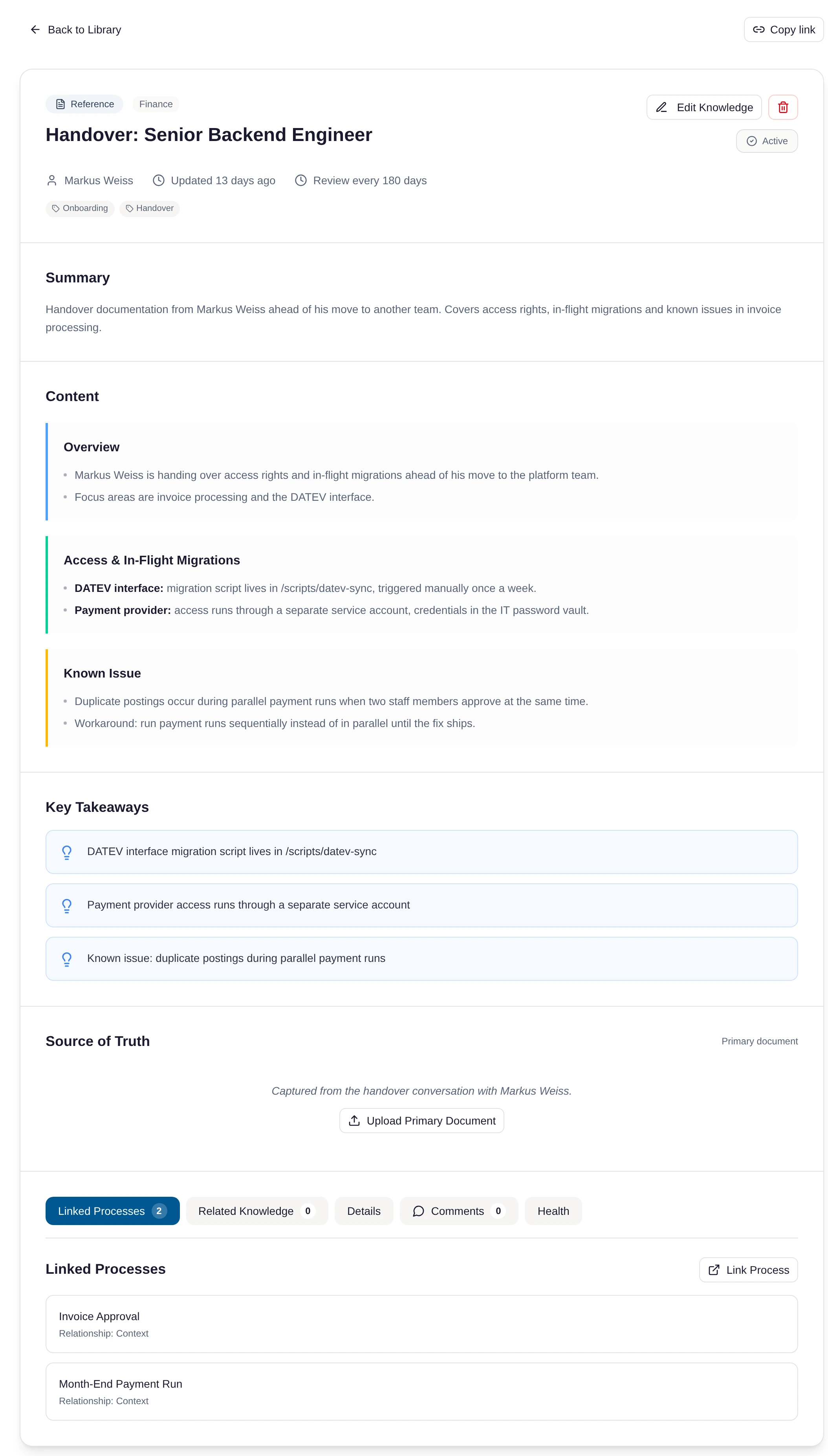
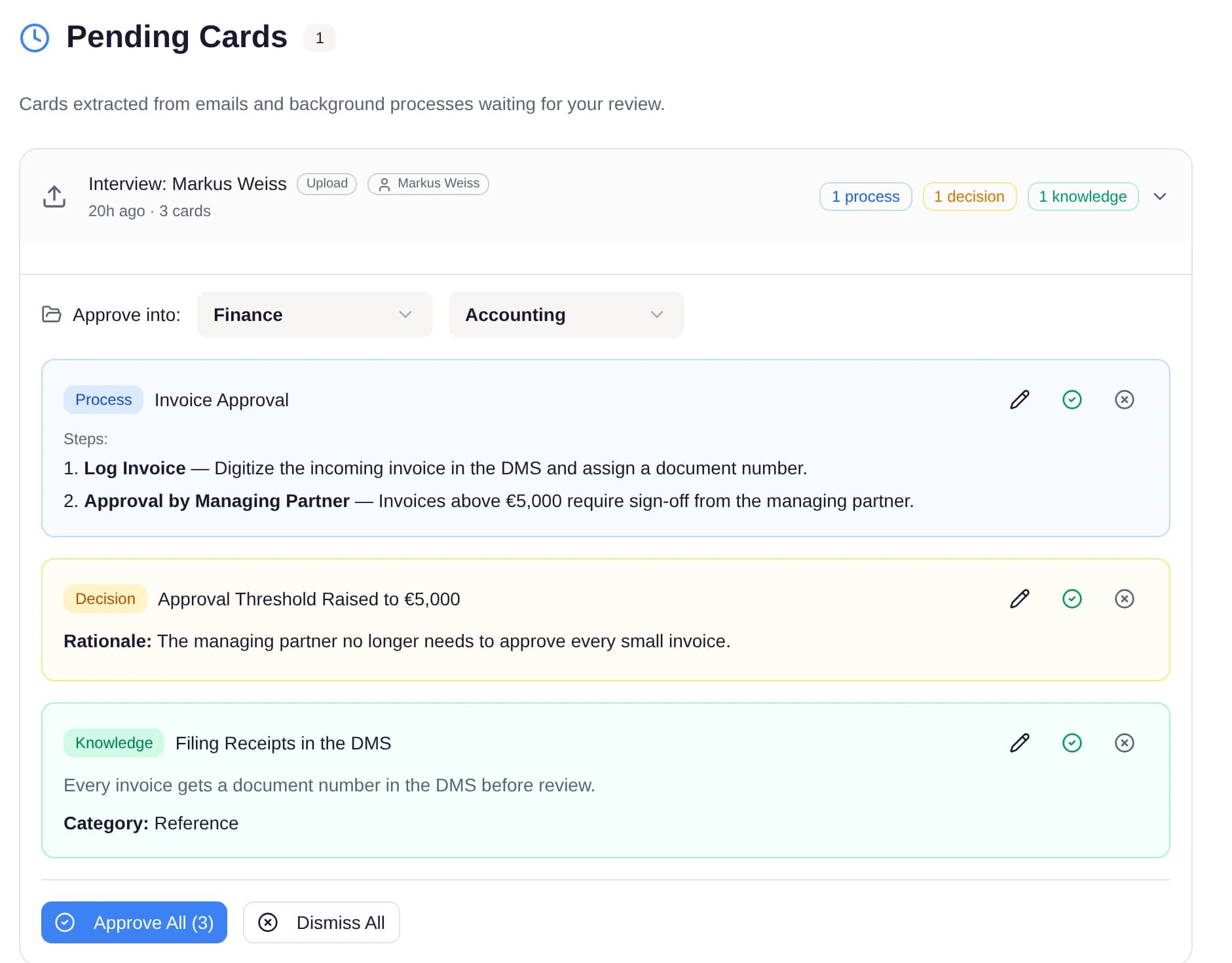
A retiring senior engineer's handover as a knowledge card — extracted from three interviews, linked to 12 process cards.
One handover interview becomes process, decision, and knowledge cards automatically.

Frequently Asked Questions

Three layers: organizational (access, hardware, contracts), human (exit interview, farewell, references), and professional (handover of tasks, clients, and knowledge). The professional layer needs by far the longest lead time.

No later than four weeks before the exit — considerably earlier for key people and retirements. Knowledge handover is the time-critical part; everything else fits into the last week.

A structured document that records what was handed over during a personnel change: running tasks, clients, processes, decisions, access, and open items — confirmed by both sides.

No law mandates it. But employers can require an orderly handover as a contractual duty — and practically, it's the only proof that knowledge and responsibility were transferred properly.

Structured handover interviews, recorded and converted into searchable knowledge cards — ideally spread over months rather than crammed into the last week. askSOPia extracts the cards from the conversations automatically.

Keep reading

Next Step

Ready to Secure Your Knowledge?

Less than the cost of a bad first month of a mis-hire.

20 minutes. No slides. No prep needed.

Start the knowledge-risk checkSee the Knowledge Sprint