
Knowledge Transfer: How to Capture Tribal Knowledge

Knowledge transfer means experience moves from heads into structures before it leaves the company. Here are the 6 methods, a 5-step plan template, and the retirement-wave playbook.

GDPR CompliantEU Data Residency

What is knowledge transfer — and what is tribal knowledge?

Knowledge transfer is the deliberate handover of knowledge between people, teams, or generations — from documentable facts to tacit experience: judgment, client relationships, lessons learned.

The critical part is tribal knowledge: the undocumented know-how that makes experienced employees valuable — how things really get done, who to call, which shortcut holds. It's roughly 80% of what leaves when a 15-year veteran walks out the door, and none of it is written down anywhere.

The 6 knowledge transfer methods

1.Structured handover interviews

The most effective method before exits: 2–3 recorded conversations along a knowledge map. Ask not what, but how and why.

2.Mentoring & tandems

Expert and successor work in parallel for months. Expensive, but unbeatable for judgment — when it's structured.

3.Shadowing

The successor accompanies the expert through real work and documents what happens implicitly: How do they prioritize? Who do they call first?

4.Process & decision documentation

SOPs secure the how, decision records the why. Together they make experience traceable instead of anecdotal.

5.Communities & lessons learned

Regular exchange across project boundaries — effective when outcomes are captured instead of evaporating after the meeting.

6.AI extraction from conversations

The scaling lever: recorded interviews and meetings are automatically converted into structured, linked knowledge cards.

Knowledge transfer plan: the 5-step template

A knowledge transfer plan answers: which knowledge, from whom, to whom, by when, in what form?

1. Knowledge mapWhich tasks, clients, systems, and decisions depend on the person? What do they alone know? Prioritize by damage-if-lost.
2. Assign receiversWho takes over which knowledge area? One receiver per area — not 'the team'.
3. Method per knowledge typeExplicit knowledge → documentation. Tacit knowledge → interviews, shadowing, tandem. Put dates on the calendar.
4. Capture & structureRecord the conversations and convert them into verified knowledge, process, and decision cards — linked, with owners.
5. VerifyThe receiver works with the transferred knowledge; every follow-up question marks a gap. Review after 4 weeks.

The retirement wave won't wait

Across Europe and the US, the baby-boomer generation is retiring — in engineering firms, consultancies, and technical mid-market companies, often half the experience carriers within a decade. Starting knowledge transfer in the last month of employment documents leftovers, not expertise.

The sequence that works: identify concentration risks first (whose knowledge depends on one person?), transfer the most critical knowledge areas first, and stretch the transfer over 6–12 months instead of 2 weeks. A knowledge graph surfaces departure risks before they become acute.

Knowledge transfer with askSOPia: conversations become cards

askSOPia makes the most effective method — handover interviews — scalable: recorded conversations are automatically extracted into knowledge, process, and decision cards, linked, and made available to the successor. Later, they simply ask the chat and get answers citing the handover as the source.
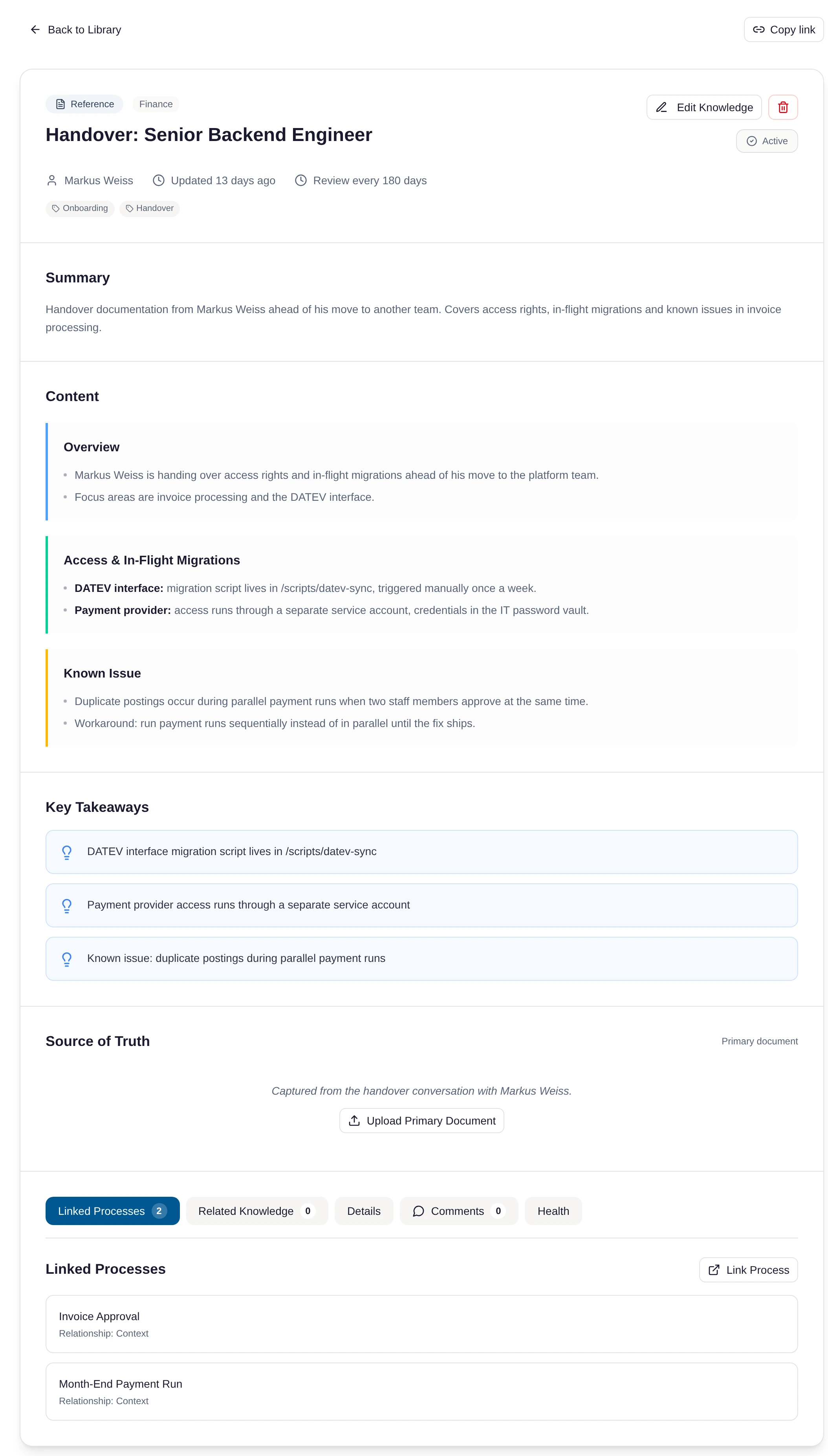
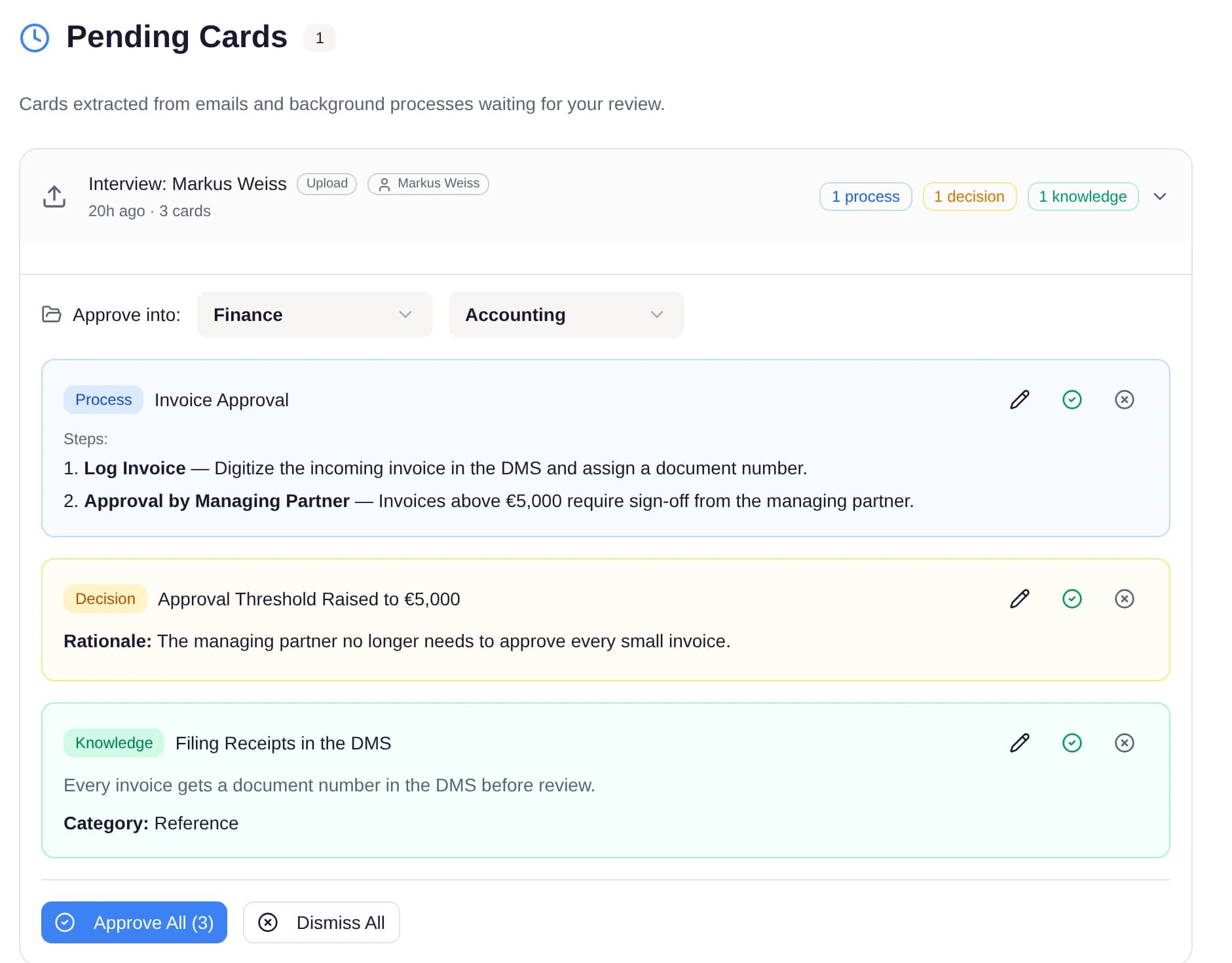
A retiring senior engineer's handover as a verified knowledge card — extracted from three interviews.
One handover interview becomes 5 cards automatically: processes, decisions, knowledge.

Frequently Asked Questions

The undocumented know-how that lives in employees' heads: how things really get done, who to call, which exceptions matter. It's the majority of what makes experienced people valuable — and it leaves with them unless it's actively transferred.

Six proven ones: structured handover interviews, mentoring/tandems, shadowing, process and decision documentation, communities with lessons learned, and AI extraction from conversations. Tacit knowledge needs conversations, not forms.

Six to twelve months before the exit — earlier for key people. The last two weeks are enough for access and formalities, not for 15 years of experience.

Five elements: a knowledge map (what, prioritized by damage-if-lost), named receivers per area, a method per knowledge type, capture into structured searchable form, and a verification step 4 weeks after handover.

By the receiver's behavior: can they execute the inherited tasks without follow-up questions? Practical metrics: open questions per week, processing time on inherited cases, and a review 4 weeks after the handover.

Keep reading

Next Step

Ready to Secure Your Knowledge?

Less than the cost of a bad first month of a mis-hire.

20 minutes. No slides. No prep needed.

Start the knowledge-risk checkSee the Knowledge Sprint